
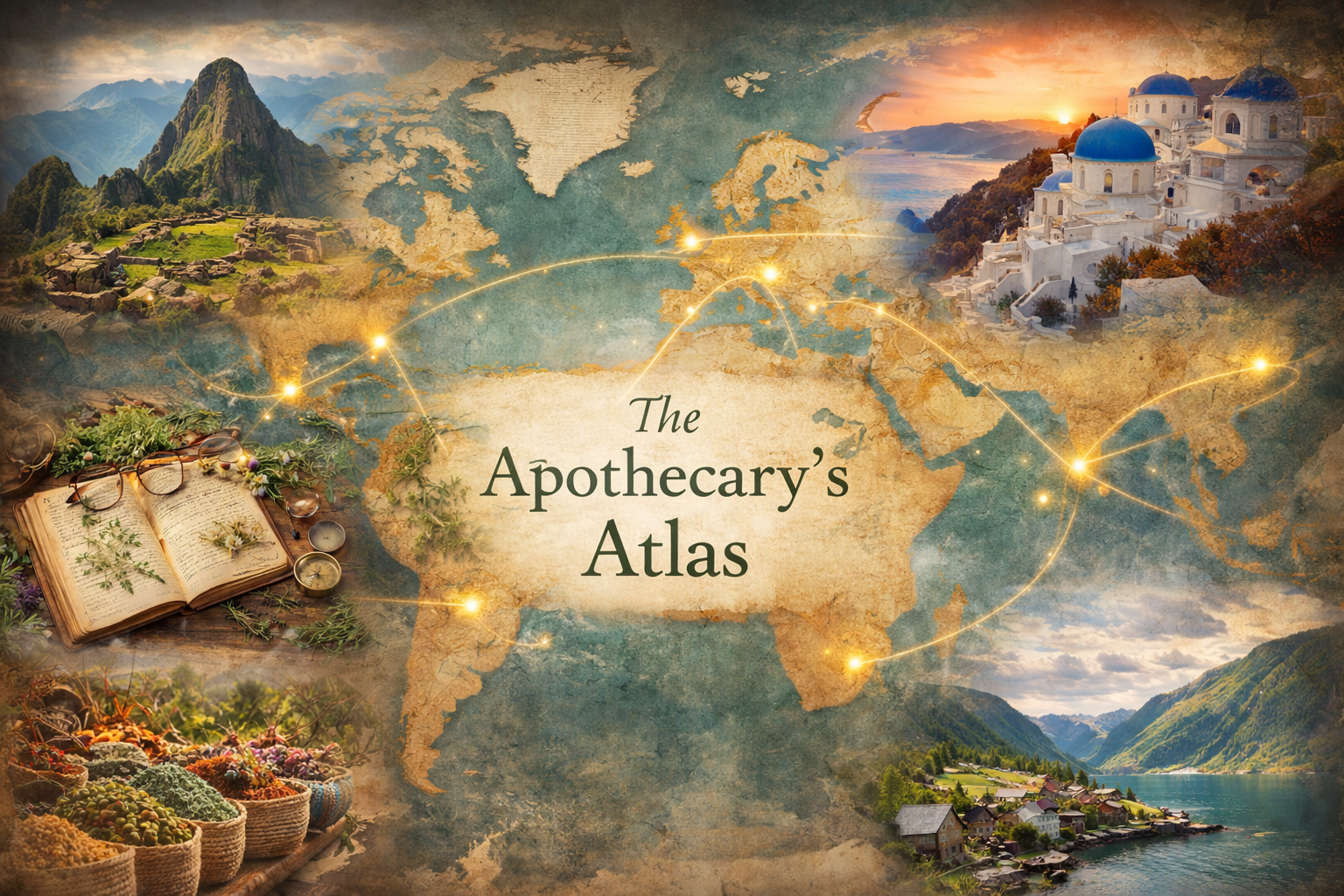
Why I Write Stories That Travel
Some stories stay in one place. Mine don’t.
When I began writing what would become The Apothecary’s Atlas, I didn’t set out to build a literary universe. I set out to follow one woman, one herb, and one healing journey at a time. In fact, I will be honest, I want a story that touched me in similar ways of a journey that Eat, Pray, Love did with Julia Roberts.
But something unexpected happened. The women began to find each other.
Across oceans.
Across ledgers.
Across letters.
Across memory.
And that is how a universe was born. I kept seeing lines, connections, friendships, kinships, and so much more. And it just wouldn’t stop. In fact hardly a day goes by where I don’t think of another connection or journey, or character to write about.
“Healing has always crossed borders, through seeds, through stories, through the hands willing to carry them.”

What Is a Cross-Border Literary Universe?
A cross-border literary universe is more than a series. It is a connected body of stories where:
- Characters intersect in subtle ways
- Ledgers travel between hands
- Herbal knowledge crosses continents
- Shared history echoes between books
- One story quietly continues in another
In The Apothecary’s Atlas, each novel stands alone, but none of them are isolated.
A herbalist in Peru may once have studied under a woman whose name appears in Morocco.
A ledger discovered in Norway may reference a traveling apothecary from Italy.
A daughter in New Zealand may carry a memory of a teacher who once walked through Greece.
These connections are intentional. They mirror real life. And I simply love each woman and her journey. They have become my friends.
Why I Build Stories This Way
Because healing is an individual journey. Plant medicine has always crossed borders. We can heal through these journeys and stories of others.
Herbs migrate.
Seeds travel in pockets.
Knowledge passes through trade routes, apprenticeships, and family lines.
When I write about:
- Muña in the Andes
- Myrrh in Egypt
- Yarrow in wild fields
- Juniper along fjords
- Lemongrass in Thailand
I am writing about place, but I am also writing about connection. I am writing the culture, the people, the lives of everyday people. People like you and I.
The world is woven in an intricate pattern. I firmly believe that if we could see a glimpse of this pattern, we would understand the importance of connections.
“A single novel can comfort you. A connected universe can remind you that you belong.”
The Power of Subtle Crossovers
Crossovers in my books are not dramatic cameos. They are quieter.
A shared teacher.
A passing mention in a ledger.
A recipe carried forward.
A name in a journal.
A letter received years later.
Why? Because that is how lineage works.
We rarely know the full impact of those who shaped us.
But their fingerprints remain.
“The world is not fragmented, it is woven. And every story adds another thread.”
By moving characters across borders, I create:
- A sense of continuity
- A living archive
- A layered reading experience
- A world that feels inhabited beyond one plot
Readers begin to notice threads. And those threads matter.
How This Shapes The Apothecary’s Atlas
Each book in The Apothecary’s Atlas centers on the plan of:
- One woman’s journey
- One main herb
- One place
- One transformation
But together, the books form something larger: A global map of healing.
From:
- The Sacred Valley in Peru
- To Tuscany
- To Santorini
- To Morocco
- To Norway
- To New Zealand
- To Brazil
- To South Africa

Each story is rooted in cultural respect and plant tradition, and yet they speak to each other. Faithfully.
If you are new to the series, you can begin anywhere.
But if you read them all, you will see:
The wandering apothecary appears more than once.
The ledger is never truly closed.
The work continues.
Explore The Apothecary’s Atlas Series Page
Why This Matters to Me
Because we are living in a time when division feels loud and chaotic. These connections and stories remind us to slow down, and remember the important parts of ourselves.
Stories that cross borders gently remind us:
We are more connected than we think.
Herbal traditions have always borrowed, blended, and evolved.
Knowledge has never belonged to one place.
Respectful storytelling honors both:
- Cultural specificity
- Shared humanity
That is the balance I strive for.
How to Read the Series
If you enjoy layered storytelling, you may want to follow the subtle threads between books.
I’ve created a companion resource to help with that:
The Atlas Reading Order Guide – Coming Soon
This guide includes:
- Suggested reading paths
- Character crossover notes
- Ledger lineage connections
- Thematic arcs
- Plant ally continuity
It is designed to deepen your experience, but it is never required. Each story stands alone. The universe simply expands if you stay longer.
Download the Atlas Reading Order Guide – Coming Soon
Building for the Long Term
When I build a literary universe, I am thinking beyond one book.
I am thinking about:
- Intergenerational continuity
- Living archives
- Characters who grow older
- Seeds that are planted now and bloom later
- Ledgers that remain open
This is not fast fiction. It is rooted fiction. And like roots, it spreads quietly beneath the surface.
A Final Reflection
A single story can heal. But a connected body of stories can create belonging. That is why The Apothecary’s Atlas crosses borders. Because healing has always traveled.
And the map is still unfolding.